I was very disappointed that I was on holiday for the 40th anniversary of the Apollo landings, because I missed a lot of the newspaper coverage and Guardian wallcharts. I'm sure the Apollo coverage would still have been available to me, but it would have been in French. Fuck that shit.
Some interesting space facts.
1. Man's first landing on another celestial body almost wasn't broadcast live.
Neil Armstrong and Buzz Aldrin stepped onto the moon about 8 hours before their mission plan said so. It basically said this:
a) land on moon
b) sleep 8 hours
c) take man's first step on moon
But they were, rightly so, all like 'nawww fuckdat' and suited up anyway. The BBC had stopped broadcasting at this point, because it was about 3 in the morning, but one guy called James Burke was listening in. He convinced the BBC to broadcast the moon landings live - the first continuous 24 hour broadcast in television history.
2. Neil Armstrong is a wanker.
A boring, uptight wanker. He hardly ever appears in public, people who worked with him on Apollo called him "aloof," "sinister," "impassive" and "unknowable." And he's shit with the press. Before Apollo 11, a journalist asked him if he could take one thing on his mission, what it would be - he said, "more fuel." Someone once asked him what it was like to walk on the moon, he said "Pilots take no special joy in walking. Pilots like flying." Buzz should've been first.
3. SPACE IS HUGE
okay. Look at this:
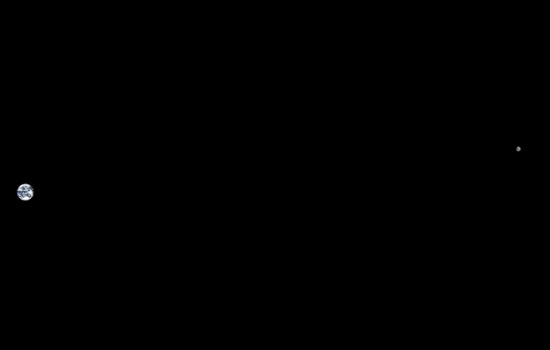
The Earth and the Moon to scale. Pretty far apart, aren't they? It's nearly 240,000 miles. People have only made that journey nine times, ever.
Right, now try and picture the above diagram inside THIS one:

That little blue dot in the box in the top left is Earth (obviously not to scale). So that's the solar system . . . OR IS IT?? Beyond Pluto, there's a belt of comets called the Kuiper Belt, like the Asteroid Belt but way bigger. Beyond that, a huge fucking cloud of comets called the Oort Cloud. The edge of the Oort Cloud marks the edge of the Sun's gravitational pull, and so the edge of our solar system.
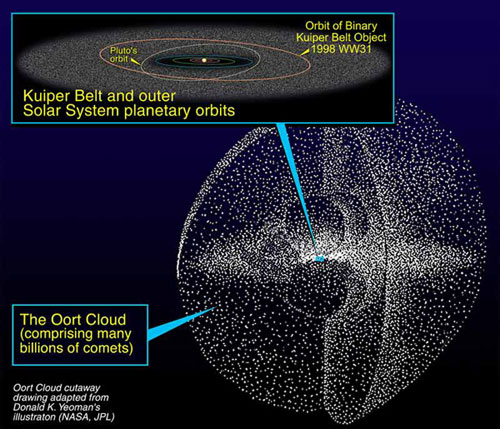
Look at that motherfucker. See at the top of that diagram, see the distance from the sun to the edge of the Kuiper Belt? A long way. About 50 AU, or Astronomical Units. An AU is about 93,000,000 miles, so from the Sun to the furthest edge of the Kuiper Belt is 4,650,000,000 miles, just over 4.5 billion.
4.5 billion miles is a fucking long way.
Okay. This next bit scares me. The distance from the edge of the Kuiper Belt, 4.5 billion miles, is one thousandth the distance from the Sun to the edge of the Oort Cloud. So, from the Sun to the edge of the Oort Cloud is 50,000AU, or 4.5 trillion miles. GAAAAAAAAAAAAAAAAAAAAAAAAAAAAAAA
And that's only our solar system. There are around 100 billion to 400 billion, or 100,000,000,000 to 400,000,000,000 other stars in the Milky Way. And in the observable universe alone, that's only the bit we can see, there are around 80 billion galaxies. Which means the estimated total of solar systems in the observable universe is 30 to 70 sextillion.
OR:
30,000,000,000,000,000,000,000 to 70,000,000,000,000,000,000,000 solar systems in the observable universe.
Also I was thinking of getting some shoes, I really want them they're really nice!! What do you all think???

kbye


No comments:
Post a Comment